MailFathom documentation
A brain for your mail — self-hosted, AI-native, and yours alone.
MailFathom is a self-hosted service that synchronizes mail from your IMAP accounts into a local PostgreSQL copy, indexes it for search, and serves it to AI agents as read-only tools over the Model Context Protocol. Reading is local, and synchronization never marks anything read on the mail server.
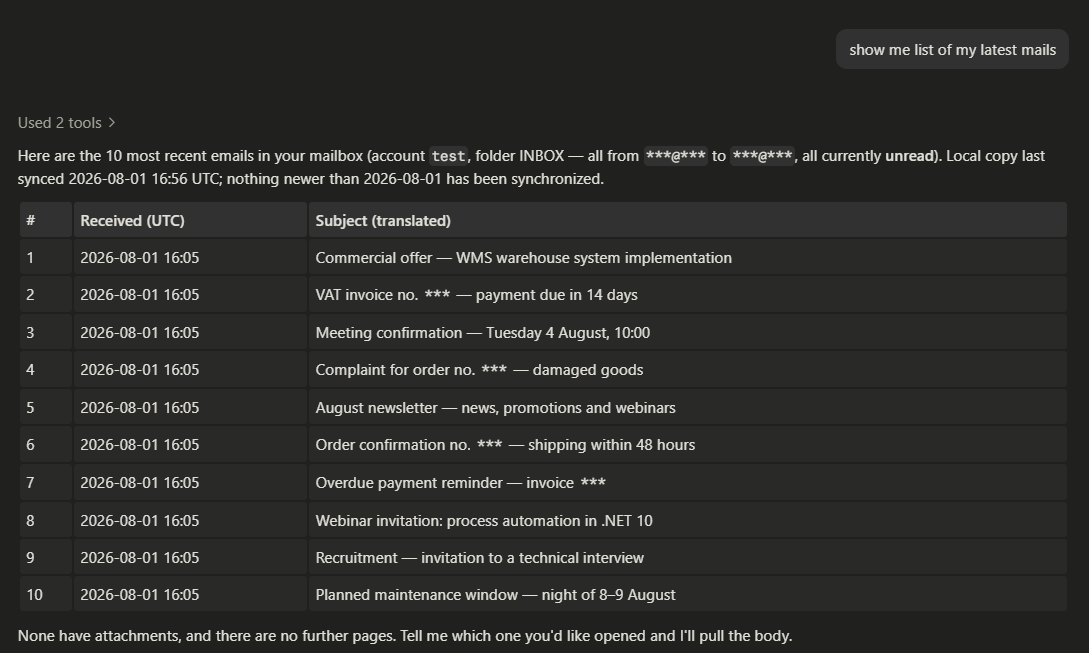
One question, answered from the local copy in an ordinary chat client. The *** were blacked out by hand before the
file entered a public repository — MailFathom redacts nothing on its way to a client.
This page is the front door of the published site. It exists only there: the file GitHub shows when you browse
docs/ is README.md, which indexes the same
pages for somebody reading them in the repository.
Where to start
| If you want to | Read |
|---|---|
| Install, configure, and use MailFathom | The user guide |
| Deploy, operate, and troubleshoot a running instance | Operations |
| Understand what the tools return and what they bound | Features |
| Follow the boundaries the code is built on | Architecture |
| Look up a type or a member | API reference |
Which version you are reading
The site opens on the current release. The selector in the header moves between the releases that are still
documented and latest, which is built from the default branch and therefore describes work no release carries yet —
a page there can document a setting you cannot configure in the version you are running. Every page states its version
in that same selector, and a page outside the current release says so in a banner.
What this site leaves out
The repository holds what is deliberately not published here: the
architectural decision records under
docs/decisions/, which are a closed record of
why a decision was taken rather than documentation of how MailFathom behaves; the specifications under
specs/, which state intent rather than fact; and the
instructions that govern the agents and contributors working on it. MailFathom is published under the
Apache License 2.0.